
Álvaro Gómez
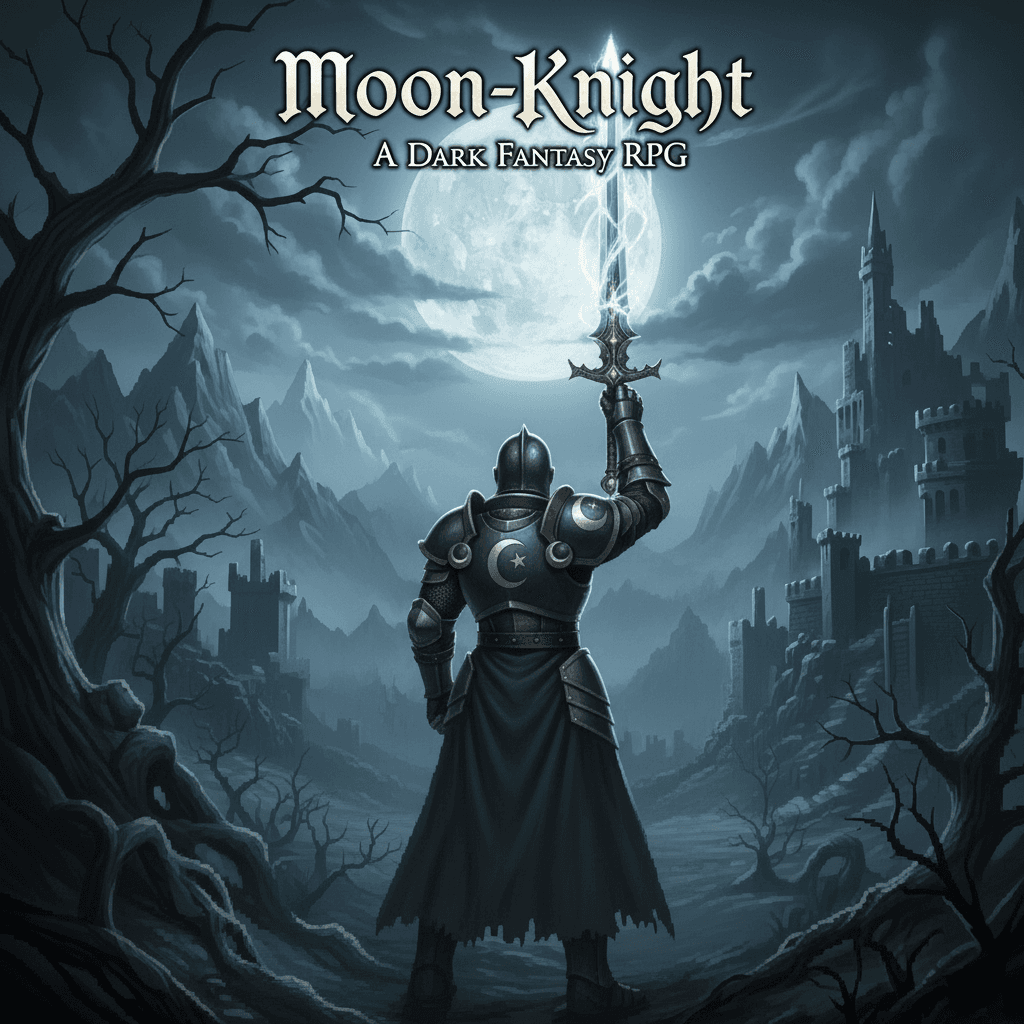
Moon-Knight key art. Armoured knight beneath a full moon, moon-phase health bar on the breastplate.

UE5 · C++ & BLUEPRINTS · SOLO PROJECT · 2025 - Present

Moon-Knight

Dark Fantasy Action RPG. Solo project, Full Authorship.

Shown at Develop:Brighton 2025

EngineUnreal Engine 5
RoleSolo Developer
TeamSolo
Year2025 - Present

The Overview

The Vision

Moon-Knight is an action RPG where I tried to think about how Quantum Computing principles could change RPG mechanics. I designed five combat abilities from these principles and built the systems. It began as my MA dissertation to research how this cutting-edge technology could change the designing side of video games, while also design every single aspect of it.

I developed a prototype. The Tutorial is fully playable where the main mechanics and systems are introduced. I built all the systems, the level design, the enemies, the interface, the C++ and the Blueprints that make the game and the music and audio design of the game.

My Role

My Contribution

Systems & combat design

Designed the full combat loop: combos, the five quantum abilities, a dual skill tree and the boss encounters showing each mechanic.

Quantum abilities design

Extrapolated quantum computing principles and translated them into video games. Each of them has their own risks and rewards, making the player learn how to use them.

Anti-farming Skill Points

Built the White Rose XP and its progression. The players have to earn the XP by playing and defeating enemies.

Design Decisions

I designed the interface with a diegetic approach. By making the UI like this, I put what the player can see on screen first without adding HUD and just blend these in the game world.

Engineering

Built the game in Unreal Engine 5. For the prototype, I firstly used Blueprints for a faster prototype. Then I rebuilt the codebase in C++ for a better performance.

Gameplay Videos

The Gameplay

Clips from the game, showing the main mechanics that make the game work.

Four Attack ComboThe four sword combo, showing the fundamentals of the combat system.
Mini-bossThe Mini-Boss combat. It is bigger than the Moon-Knight for better vision. Dodging the attack is crucial.
Boss fightThe Werewolf fight. Dodging and attacking in a fast-paced combat.

The Quantum Abilities

The Quantum Abilities

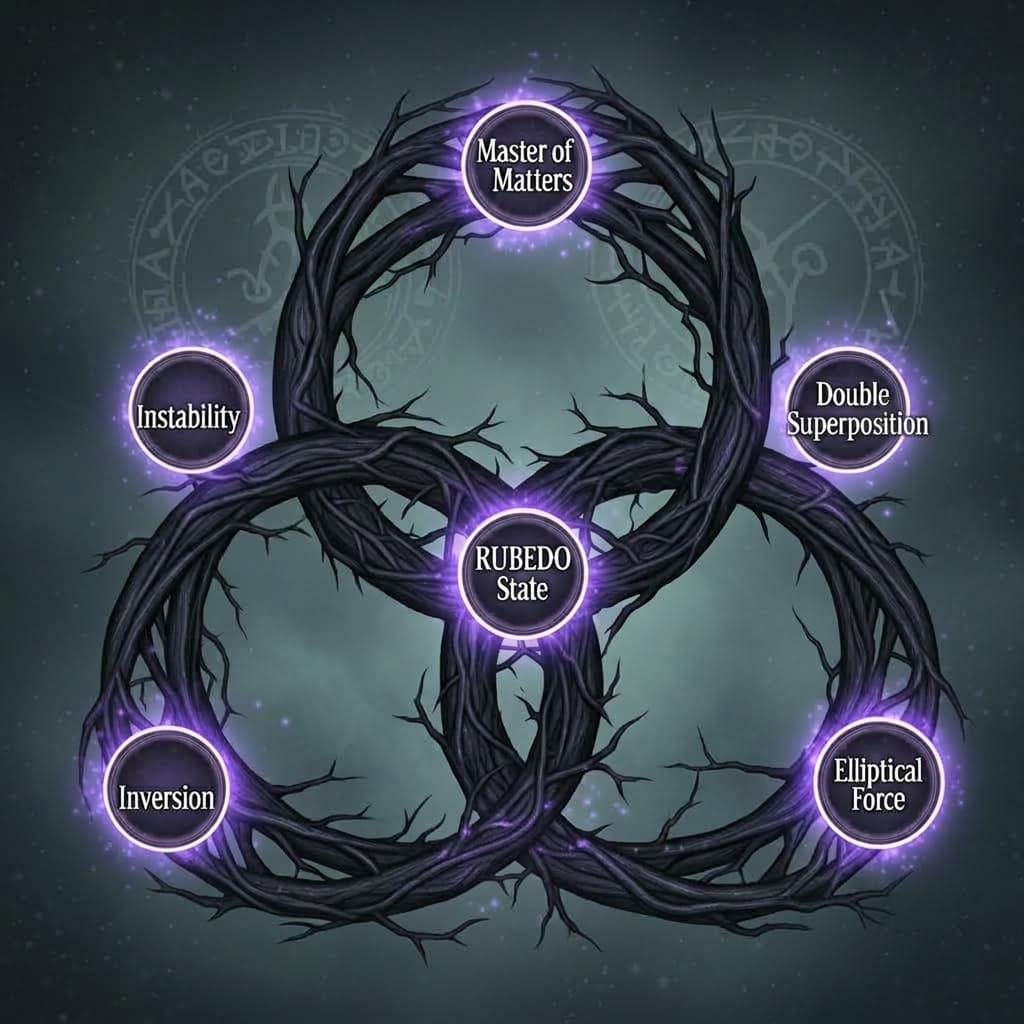
Five abilities built on a real quantum computing principle. One equipped at a time with high risk and high reward.

InteractableChoose any disc and that ability's quantum basis and what it does in play read out beside it.Click, tap, or press Tab to reach it and then Enter.

The Rubedo sigil from the game's design document: three interlocking rings of thorned black branch on a misty green ground, the Rubedo state at their centre, and the five quantum abilities set in glowing violet discs around them.

AbilityPlayer & enemy

Master of Matters

Quantum basis

Majorana states · topologically protected qubits

In play

Embed the sword with different elements: Fire, Lightning and Water. This applies more damage and is very effective against enemies made out of a certain material or whose defences are very useful against normal melee attacks. The ability rewards players who learn the enemies' defences and penalises players by wasting an equipped slot.

Master of Matters selected · Majorana states · topologically protected qubits

The Enemies

Bestiary

Liber Monstrorum · Moon-Knight

The Four Bosses

One quantum mechanic each

Boss I

The Werewolf

The first big challenge.

Quantum mechanic

Instability

Throws an orb that changes speed and size on contact with anything from the environment.

Lore

It was sent by the Sun-Knight, captured and tortured. It turns on the soldiers that are coming to get you.
Boss II

The Wizard-Knight

Once a servant of the Moon.

Quantum mechanic

Inversion

An undodgeable attack. The player must parry it with the Inversion ability. He can counter yours in return.

Lore

Once a servant of the Moon, he turned against her.

Boss III

The Centaur-Knight

Hidden all his life, until he found alchemy.

Quantum mechanic

Master of Matters

Attacks using several states of matter.

Lore

Hid all his life because of his appearance. He found strength in alchemy, and alchemy drew him to the Sun-Knight.

Final Boss

The Sun-Knight

The Moon-Knight's partner, before the betrayal.

Quantum mechanic

Elliptical Force

Throws two orbs, a Sun and a Moon, on elliptical circles that collide on the player.

Lore

Once the Moon-Knight's partner, he betrayed the Moon. The last fight in the game: every soldier the player has fought against followed him.

Basic Enemies

Soldiers

Equipped with a sword. The combat is similar to the player's. They cannot dodge, jump or heal.

Weakness

No elemental weakness

Fallen soldiers following the Sun-Knight.

Wooden Humanoids

Camouflaged as trees. Spear in melee, thrown splinters at range.

Weakness

Fire

Once soldiers, who rested so long they became tree-like.

Amphibian Humanoids

Swamp dwellers. Strong-arm melee and a long tongue at range.

Weakness

Cut the tongue mid-attack

Once swamp people, who adapted to survive.

Banshees

They hide in the fog and sing a beautiful song to attract you then strike with claws. The fastest enemy in the game.

Weakness

Lightning

Cursed royalty, turned into monsters.

Ghosts

Invisible until very close. The fog moves oddly to warn you.

Weakness

Light

Cursed royalty, turned into monsters.

Ice Knights & Wizards

Wizards strike at range and are weak to melee. Knights attack with ice swords.

Weakness

Ice, or melee for the wizards

Revived by star-seeking wizards to protect them.

AI Blueprints Systems

Blueprint · Triggering enemies through sight detectionThe detection system that the majority of the enemies share. The sensed stimulus writes you into the Target Actor key that the Behaviour Tree reads. This system lets the player deactivate the stimulus, leaving the fight whenever needed.
Blueprint · Boss bar only appearing during the bossfightWith this Blueprint, the boss' health bar only appears when they are triggered. This HUD disappears when the boss is defeated or when they lose sight of the player.

The Input Map in a Controller

The Controls

The pad

The Controller Map

Things are worth reading off it. There is no block button and two triggers change meaning the moment a fight starts.

InteractableChoose any control and the pad and the list light up together, and its reasoning reads out beside them.Click, tap, or press Tab to reach it and then Enter.

Moon-Knight gamepad layoutA stylised modern gamepad. Across the top, the left trigger is Use bow, or Parry once a fight has started, and the left bumper is Raise weapon; the right trigger is Pick up item or throw arrow, or the heavy attack in combat, and the right bumper is Melee attack. The left stick moves the character and clicking it goes into stealth; the right stick moves the camera and clicking it locks on to a target. The D-pad is the spell grid, its four directions casting the four quantum abilities the player is given. The four face buttons are Y for Heal, X for Talk to NPCs, B for Dodge and A for Jump. The small View button opens the equipment system and the Menu button pauses.LTRTLBRBL3R3YXBA

Sticks

Left stick
Move character
L3
StealthHaving the stealth in the moving button allows the player to access this move quickly.
Right stick
Move camera
R3
Lock on to targetThe same reason as stealth: Easy access while moving the camera.

Face buttons

Y
HealThe harp. Healing requires the player to fully stop. There is no inventory.
X
Talk to NPCs
B
DodgeUnlimited, with i-frames, to keep aggressiveness in the combat system.
A
Jump

Shoulders & triggers

LB
Raise weaponThe navigation animation: lift the sword, catch the moonlight and the light points the way.
LT
Use bowIn combatParry
RB
Melee attack
RT
Pick up item / throw arrowIn combatStrong melee

D-pad

D-pad
The spell grid. It selects and casts a Quantum Ability.Four directions for the abilities the player is ever given: Master of Matters, Instability, Inversion and Elliptical Force.

System

View
Equipment system
Menu
Pause menu
This is the Animation Montage of the first attack. The space between the two notifies of the animation is the time that the player has to concatenate attacks. If the player presses the input outside of this time the attack combo will fail. This is the connection between the animation and the Blueprints.
Blueprint · the combo continuationThis is the logic of the combo continuation and how the game detects the player's attacks. Each swing opens the bool Save Attack? while its window is true. The next input either arrives inside it and the switch fires the next attack in the chain, or it does not and the graph falls through to Stop Combo.Prototyped in Blueprint because a timing window is tuned in seconds there, and moved into C++ once the numbers stopped moving.
Blueprint · how the sword applies damageThis is the Blueprint logic that was attached to all the swords in the prototype. A Notify opens the trace when the swing should cause damage and another Notify closes it. The graph also casts to the BP_AI, making the enemies' attacks follow the same rules and applying damage only during certain parts of the animations.

Kaelum and How It Was Planned

The World and Level Design

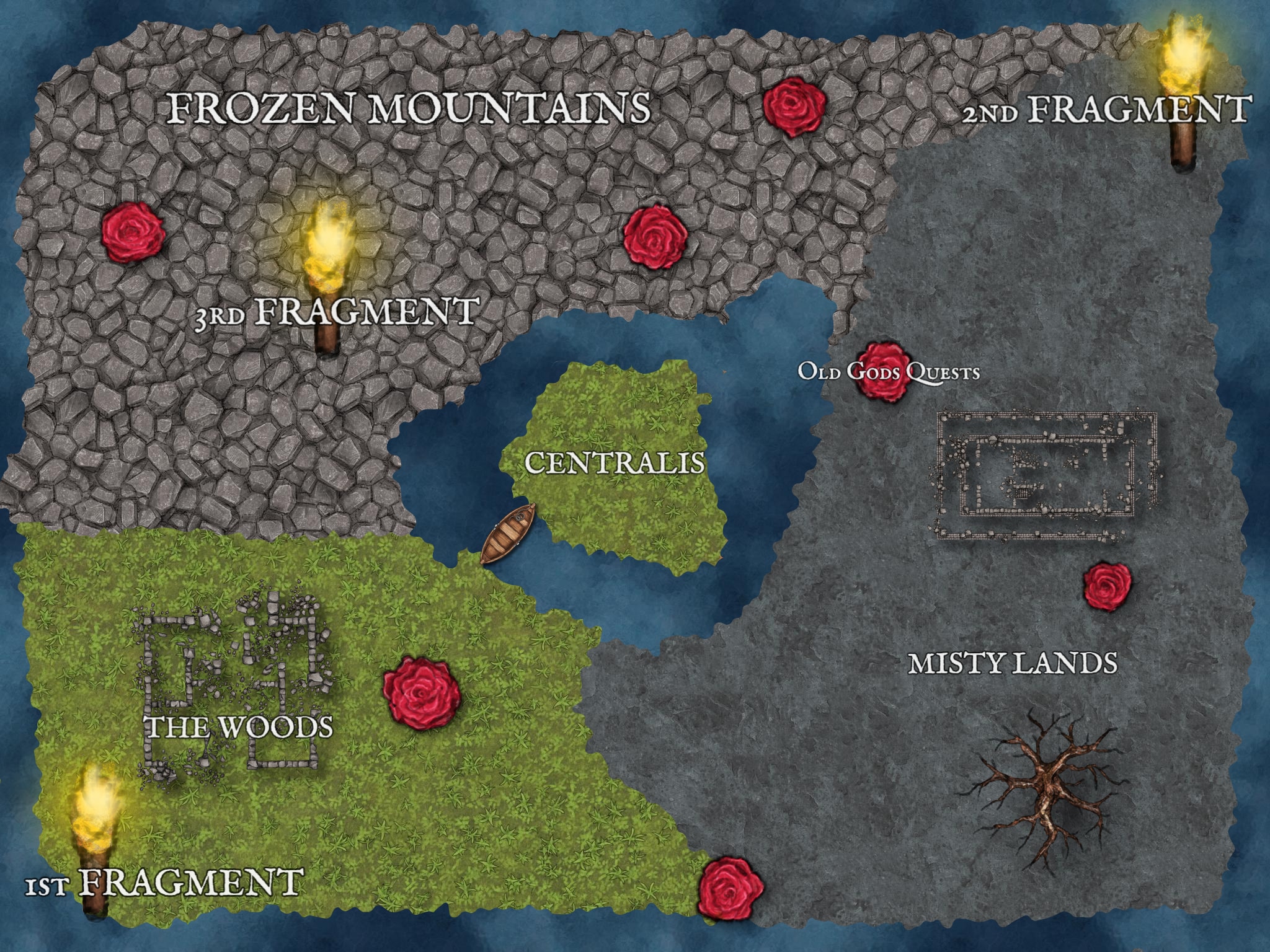
This is the drawn map. The chart answers what it is like to play and every place on the map opens its level on the chart.

The map

InteractableChoose any sigil and its lore, who is there and what guards it read out below.Click, tap, or press Tab to reach it and then Enter.

Hand-drawn map of Kaelum: the Frozen Mountains in grey across the north, The Woods in green to the south-west, the small green island of Centralis at the centre with a boat beside it, and the fog-grey Misty Lands filling the east, all surrounded by sea. Three torches mark the fortresses holding the Moon Fragments, and roses mark the Old Gods quests.

Land

Centralis

Where the game starts. The Moon-Knight wakes up from a coma here. The land is covered in dark trees and surrounded by water. The NPC Death is waiting here. This section is the tutorial and leads to The Woods when completed.

Enemies
SoldiersBoss The Werewolf
Land
Centralis, the lake island where the journey begins, and the three great levels. Each area covers one act in the narrative, they are listed in the order they are played.
Fortress · Moon Fragments
The Fortresses stand on high ground, visible at all points in the level. Lots of enemies await inside. There is a moon fragment in every single one of them, guarded by a boss that defends it.
Dungeon · Old Gods Quest
The Dungeons are underground and they are guarded by enemies that were never human. They are well-hidden and difficult to access. Here is where the Power of the Gods abilities are gained.

The plan

InteractableChoose any level and its full design sheet opens below the chart.Click, tap, or press Tab to reach it and then Enter.

Four levels: a prologue on the lake island, then one act per land. Each represents each moon phase that the game is in. From a silent island to a full moon over the Sun-Knight. The world should feel like it is from an epic novel.

Centralis is the tutorial, not a full level. The three acts are the three lands that follow it, one fragment each.So the moon waxes as the player progresses and collects the fragments.

Level design beat chart. Rows are design dimensions, columns are the four levels in play order.
SpaceLake IslandMoving woods and a cemeteryCity of Mists and a Haunted Castle in ruinsThe catacombs & the astronomers' castle
ObjectiveGet to the boat and escapeGet the Crescent Moon FragmentGet the 2nd Moon FragmentGet the 3rd Moon Fragment
Story / QuestPrompt startNot part of this levelEnd the banshees' menaceFollow the Witch, the Druid, or Death
BossThe WerewolfThe Wizard-KnightThe Centaur-KnightThe Sun-KnightFinal
VisualsDark spaces and green scenariosGreen scenarios in the rain, colourful flowers next to swampsFoggy scenariosRocky & snowy
AudioFootsteps (silence)Whispers in the wind that increase tensionVoices singing in the fogHigh-pitch music & harmonics
  • Level 1 · Tutorial · Waxing crescent

    Centralis

    Space
    Lake Island
    Objective
    Get to the boat and escape
    Story / Quest
    Prompt start
    Boss
    The Werewolf
    Visuals
    Dark spaces and green scenarios
    Audio
    Footsteps (silence)
  • Level 2 · Act I · First quarter, waxing

    The Woods

    Space
    Moving woods and a cemetery
    Objective
    Get the Crescent Moon Fragment
    Story / Quest
    Not part of this level
    Boss
    The Wizard-Knight
    Visuals
    Green scenarios in the rain, colourful flowers next to swamps
    Audio
    Whispers in the wind that increase tension
  • Level 3 · Act II · Waxing gibbous

    Misty Lands

    Space
    City of Mists and a Haunted Castle in ruins
    Objective
    Get the 2nd Moon Fragment
    Story / Quest
    End the banshees' menace
    Boss
    The Centaur-Knight
    Visuals
    Foggy scenarios
    Audio
    Voices singing in the fog
  • Level 4 · Act III · Full moon

    Frozen Mountains

    Space
    The catacombs & the astronomers' castle
    Objective
    Get the 3rd Moon Fragment
    Story / Quest
    Follow the Witch, the Druid, or Death
    Boss
    The Sun-KnightFinal
    Visuals
    Rocky & snowy
    Audio
    High-pitch music & harmonics

Level 1 · Tutorial · Waxing crescent

Centralis

Lake Island

An island and one way to get out of it, fight your way out.

Space & goal
Space
Lake Island
Objective
Get to the boat and escape
Story / Quest
Prompt start
Threat
Boss
The Werewolf
Mood
Visuals
Dark spaces and green scenarios
Audio
Footsteps (silence)
The section summary: the environment · the audio · the enemies.
  1. CentralisShadows · Silence · Soldiers
  2. The WoodsSwamps · Whispers · The Forest
  3. Misty LandsFog · Singing · Banshees and Ghosts
  4. Frozen MountainsSnow · Harmonics · Ice Knights

The Level Design

In-game screenshots of the game. Each picture shows the level design choices that were reviewed while the level was being built.

Centralis · overview of the levelThe main four decisions: The forest functions as a natural barrier reducing the light of the main area of the level and hiding enemies. From here, the player has the three guides in front of them. The Moon, The Willow Tree and The Sword. The sword is also intentionally placed under the brightest spot the player can see at spawn.The layout of the level is hidden from the player until they get to the sword pickup spot and then the layout is fully revealed. With these decisions I try to communicate with the player through the level
Centralis · the forestThe same level from the floor. The moon serves a double function by giving natural light to the level and the direction towardswhere the player should go. The enemies are placed in the dark between the trees, which is what makes the combat short-range and fast.
The werewolf boss arenaThe boss stands on a hill so it is seen from anywhere in the arena, and the arena gives space so the player has space to dodge.

My design philosophy

The UI and Systems Design

willow treesThese trees are the player's checkpoint and safe space. It is the only place the player can heal fully.

The philosophy

The health, the progression and healing are alive in the world.

These could have been a bar or an overlay, but instead they are an action in the world. By making the systems like this, I prioritise the player's on screen view and make the game have more amplitude. Health is always in the centre and can be seen easily. The progression doesn't tell where to go exactly, just to which direction. Making the healing process play an instrument creates a bond with the melody and the player, especially if it's done in the safe space.

Where it stops

The equipment system is still a conventional menu. I thought it was the better way to represent the items and the system since this is a system that players can take more time to feel comfortable since it is interactable and not information that is just read like health and direction.

The health bar is a moon

  1. Full Moon

    The health bar is full.

  2. half-Moon

    The health bar is at 50%

  3. waxing crescent

    A small light in the circle, health is very low.

  • Replaces theHealth bar

    The Moon Health Bar

    The health bar is a moon on the knight's armour. Full health is a full moon, but as you take damage it transforms into a half-moon, then to a new moon.

    WhyI decided to put the health bar where the player is going to look most of the time since it's the stat that is going to be read the most. The player's eye never leaves the world, while also being the most important figure in the game's world.

Game Systems

  • Replaces theXP & levelling

    The White-Rose XP System

    XP comes only from defeating enemies and following objectives. The player has to stain a white rose with the boss's blood, making each one of them one XP.

    WhyI wanted to prevent farming XPs, so I conditioned these levels to objectives and bosses. This also makes it easier to tune the difficulty since there are limited XP across the levels. It also relates to the narrative instead of guessing how much XP each enemy costs.

  • Replaces theMap & compass

    Moonlight

    There is no map or compass, so I had to think of how to tell the player where to go. Raising the sword to catch moonlight points to the next Moon Fragment.

    WhyI wanted the player to experience the world rather than look in a map for directions. It forces the player to recognise the places and puts a lot of weight on the level design, which has to guide with the environment

  • Replaces thePotions & rest menu

    Healing by Playing an Instrument

    Death gives you a harp. You heal by playing it and can only heal fully at a willow tree, where the music has more harmonies mysteriously.

    WhyI wanted healing to be emotional and to have a meaning for the player, so I made healing a very touching action. Making them only fully heal at the willow tree conditions the gameplay and makes healing in a checkpoint more emotional and memorable.

The Other XP

By defeating the main bosses, the player gets XP for upgrading their combat skills.

  1. Sword

    The melee upgrade

    This upgrade grants the player a normal upgrade in their sword's attacks.

    Last tier costs 2 XPsDiegetic design

  2. Bow

    Long Distance Upgrade

    This upgrade grants the player a normal upgrade in their bow's attacks.

    MaxBowDamageBonus = 100.0fEngineering · tuning constants

Core combat, for completeness

  • Weak meleeFast, chains, low commitment.
  • Strong meleeSlow, staggers, punishable.
  • DodgeUnlimited, with i-frames.
  • ParryTight window, high reward.
  • BowRanged opener, finite arrows.
  • StealthBreak line of sight, open unseen.

The Blueprints

The Health in the HUDI tied the health and its representation to the HUD and wired them properly so the enemies could also inherit from this system. Due to lack of time, I could not make the diegetic health bar as a moon, but the system was built for making it work with any kind of UI.
Diying sequenceFor the death sequence I decided to make all the characters go to ragdoll and if the player dies, have a fade to black screen. When I reworked it in the C++ codebase, I wired the respawn at the last willow tree the player rested at, making them checkpoints rather than forcing the main spawn.
Pickup mechanicThe trace runs forward from the camera towards a pickable object in front. I chose this instead of a HUD. Players are hinted to pick up an item through context. The weapon goes into the equipment system and the mesh in the world is destroyed.

Invisible Design

The Combat and RPG Design

Four key design decisions and their reason.

No difficulty selection
WhyThe enemies have the difficulty they were designed to have. The fight the designer built is the fight that gets to the player.
Loading screens
WhyElevators, the environment covering spaces and doors could help as loading screen while the player is doing something else. Trying to smooth gameplay as much as possible.
No blocking
WhyI wanted the players to be aggressive while they play and blocking created the opposite circumstance. Removing it I had to also tune the combat: dodging doesn't consume stamina, adding a parry and constant movement.
Saving only at willow trees
WhyResting resets the area, like in a soulslike. The tension reappears once the player leaves the tree.

The Sublime

The Art Direction

The Sublime and their way of romanticising the medieval ages is what inspired the artstyle direction. This art philosophy adapted to games, exposes the player to solitude, open spaces and big challenges whether internal or external.

LandscapesThis screenshot shows a miniboss next to ruins and under the moonlight. Big landscapes and big challenges turned epic.
RuinsRuins are a big part of the game's setting. They show how the society that built them functioned, their religion, their aspirations or their fears. By making them ruins, it creates the sensation in the player that everything has an end and is eventually forgotten and buried by nature.
The title screen

The Artistic Approach

The Sublime: The beauty of experiencing a ruined world in solitude.

Click here forThe Full Sublime Artstyle Direction and art decisions

The Development

The Quantum and Engineering Design

Design Challenge

The game was designed to have video game mechanics inspired by quantum computing, trying to imagine how this technology could change the media without breaking the main rules of video games and interactive media. Unreal Engine's Blueprints don't have a way to represent them properly. I documented where this technology could excel in the video game media and where it felt like quantum computing was unnecessary. The quantum skill tree was the best way to translate these principles. I am rebuilding the codebase using a C++17 library called QPP that wraps Quantum++ and Eigen, as well as researching how to use this technology to improve the media.

EngineUnreal Engine 5
SystemBlueprints / C++
ResolutionDocumented the technology limitations and carried it into a C++17 quantum toolkit.
2025

Designed all five quantum mechanics and documented why Blueprints could not fully represent them.

2026

Building them in C++ as a quantum toolkit that can be used in every engine, statistically verified.

Current status

Developing a quantum toolkit and verifying the mechanics statistically.

Click here forHow I programmed the game: the C++ and Blueprint architecture Click here forThe Quantum Research and the C++ Quantum Toolkit

The Soundtrack

The Audio and Music Design

Main audio design decisions

Most of the game, the player is alone with their own footsteps.

The recordings

These pieces were made to make the player feel small, by focusing on the use of reverbs. Both pieces are melancholic on purpose. The music is currently unavailable but I will submit it soon and are available on request.

Click here forHow the soundtrack and the audio design were done and its reasoning.
The deep dive

The World, the Story and the Music

The full length of the project. The Narrative Design, the NPCs and their story, the worldbuilding and its symbolism, and the full art-direction argument. How the music and the audio design was planned, the jousting minigame and the potential DLCs.

Click here · Read the deep dive
The codebase

Programming Moon-Knight

The engineering side of the project. The limitations of Blueprints translated into C++ and the main code choices. The combat state machine, the data-driven layer and the quantum C++ engine limits.

Click here · Read the engineering side

Go to other projects